Have you ever sat in silence and truly gazed at Jean-François Millet’s masterpiece The Angelus? In a field at dusk, where the sky burns red as the day sinks into evening, a peasant couple pauses their weary labor. To the distant sound of the evening bell, they bow their heads deeply. Within that canvas there is no dazzling stained glass, no majestic swell of a pipe organ. There are only rough hands stained with soil, breath still heavy from work, a basket of potatoes at their feet, and a deep, weighty silence lifted toward the heavens. The essence of faith does not begin with ecstatic fervor under brilliant lights, but with the fierce, quiet resolve to fold one’s hands in prayer in the very middle of an ordinary, threadbare life.
The Everyday Prayer Echoing Across the Twilight Field
The scene of quiet devotion etched into Millet’s painting closely parallels Paul’s noble final testament to his spiritual son Timothy as he faced the end of his life. In an age that appears glittering on the outside yet hollow at its core—an age overflowing with words but lacking the weight and responsibility of lived conviction—what, then, should we take as our compass?
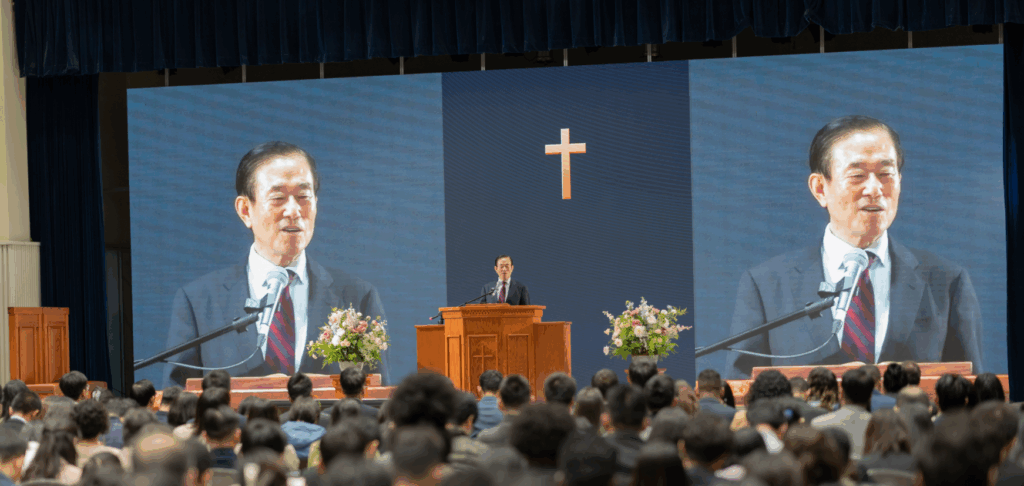
Through his exposition of 2 Timothy chapter 3, Pastor David Jang sharply diagnoses the “power of godliness” that the church of today has lost, offering a piercing theological insight. The true gospel he proclaims does not stop at intellectual agreement, at a mere nod of the head. It continues into obedience that walks across rough fields; it is not a fleeting admiration for a sermon heard on Sunday, but something brought to completion in patience and practice at the dinner table on Monday night. Godliness does not pour out from extraordinary religious experiences; it reveals its power only when small acts of obedience, carved into the daily schedule, accumulate with steady firmness.
Muscles of Faith Blooming on the Stone Heap of Lystra
The everyday world we stand upon often turns into the cold stone ground of Lystra. The brutal suffering Paul endured there—stoned for proclaiming the truth and pushed to the brink of death (Acts 14:19–20)—did not end as a mere episode in ancient history. Our Lystra today changes its clothes and returns under new names: malicious comments hurled by anonymous tongues, a culture of endless comparison that gnaws at the soul, merciless “cancel culture,” and the deep depression born of isolation.
Yet Pastor David Jang interprets these sufferings not as signals to evade or escape, but as God’s invitation into deeper maturity. Rather than instantly calming the violent storm, the Lord often desires to shape our vessel to become sturdier in the very center of the tempest. Like Timothy, who did not stand at a distance to watch the persecution but stayed close in tears, a community woven tightly with truth and love embraces one another’s wounds and forms a solidarity stronger than any threat the world can raise.
Passing through this piercing wind with our whole bodies, we come to feel the true grace of the cross. We begin to experience how ten seconds of silence—closing the lips even when wronged—can bloom into the muscles of faith that overcome the world.
The Family Table Becomes the Greatest Sanctuary
Then how, in the midst of such a fierce and chaotic world, can we pass on unchanging truth to the next generation? The answer is hidden in the most private and ordinary space of all: the home. Timothy’s steadfast faith did not sprout from programs in grand sanctuaries, but from the gentle Scripture stories spoken over him on the lap of his grandmother Lois and his mother Eunice.
In an age when post-truth confusion and algorithmic bias constantly steal our attention and hearts, Pastor David Jang powerfully presents the recovery of family worship and deep, sustained meditation on Scripture as the greatest alternative for spiritually equipping the next generation. Emotional inspiration gained from a single hour-long Sunday gathering once a week can never carry us over the relentless waves of secular life that crash in daily. Our children do not meet the living God by memorizing rhetorical perfection; they meet Him through the honest gratitude their parents voice at the table, through the posture of listening all the way to the end, and through the holy sight of a parent laying down pride to apologize first even after failure. When parents stand as the first shepherds and the home becomes a small church, the Word finally slips free from the confines of print and takes its place as the living structure of life itself.
A Holy Routine of Fifteen Minutes: Firmer Than Grand Declarations
The ultimate power of the Word lies in its dynamic movement: teaching, rebuking, correcting, and training in righteousness (2 Tim. 3:16–17). Truth is not a cheap incantation that justifies selfish desire. It is the light of life that leads us onto the narrow path where piercing repentance and thoroughgoing service await.
To those who wonder whether such a simple yet essential path of faith is even possible for busy modern people, Pastor David Jang strongly emphasizes “the great power of small routines.” More than emotional passion that flares up only to cool quickly, a steady routine—stopping briefly at a set time each day to examine one’s heart, choosing honest integrity quietly at work—holds the soul with far greater strength. A single line in a report written without compromise on a Monday morning, a truthful decision that refuses to give up even at personal loss—these become the most fragrant worship of life lifted up toward the world.
The “faith lived out as life” that Pastor David Jang has tirelessly testified to in this generation blossoms into vivid beauty precisely within such everyday sincerity. When people gather to confess their weaknesses to one another and translate the insights of Scripture meditation into the concrete language of daily living, faith becomes an unshakable fortress. Like Millet’s peasant couple, a day spent silently sowing seeds of prayer with dust-stained hands—this small yet mighty obedience—will become the brightest light to drive back the spiritual darkness of our time.